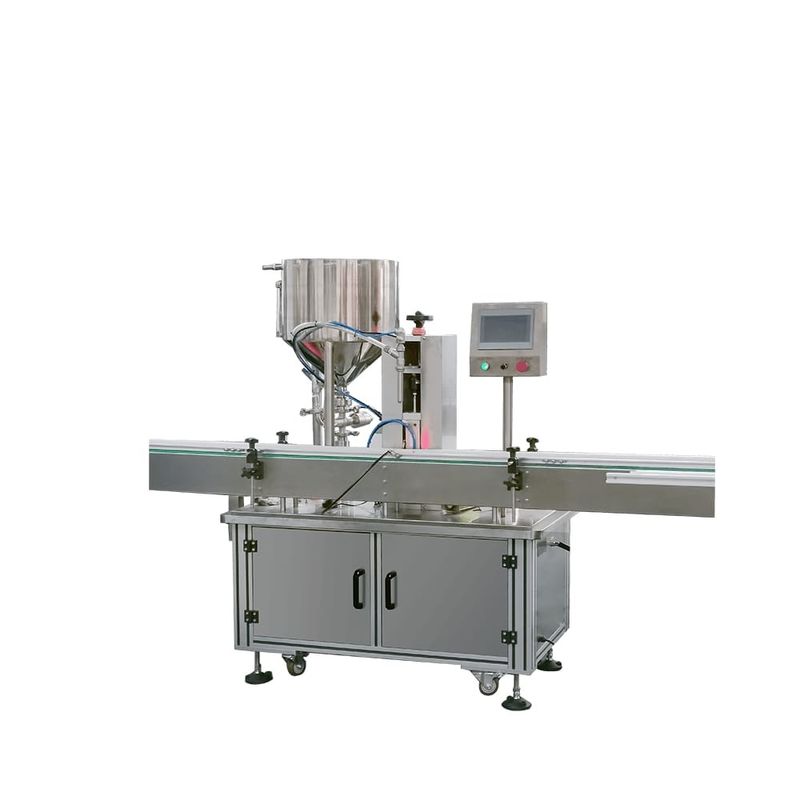
How Does a Balm Filling Machine Work?
A balm filling machine uses an automated system to accurately fill semi-solid products into bottles or jars. Containers move along an SS conveyor and are precisely positioned under the filling nozzles through an indexing mechanism for accurate alignment.
The machine uses specially designed nozzles to ensure smooth filling and reduce foaming. A “no bottle, no fill” system prevents spillage by allowing filling only when containers are in place.
After filling, the containers automatically move to the next stage, such as capping or labeling, ensuring a continuous and efficient production process.
How the Balm Filler Transfers Product?
A balm filling machine typically uses a piston pump system to transfer product from the hopper into containers with high accuracy and consistency.
First, the semi-solid product is stored in the hopper, ready for dosing. When the piston retracts, it draws a precise volume of material into the cylinder, ensuring each cycle captures an exact measured dose.
Next, during the discharge phase, the piston moves forward and forces the product out through the filling nozzle. At the same time, a synchronized valve system controls the flow so the material is delivered directly into the positioned container, reducing waste, dripping, and contamination.
This controlled suction-and-discharge process enables stable, repeatable filling performance for bottles, jars, and similar containers, keeping the production line efficient and ensuring consistent packaging quality.
What Factors Should Be Considered When Purchasing a Balm Filling Machine?
Selecting the right balm filling machine is essential for ensuring stable production, accurate filling, and long-term operational efficiency. Below are the key factors to consider before making a purchase:
1. Machine Construction and Material Quality
Choose equipment made from high-grade stainless steel to ensure hygiene, corrosion resistance, and durability. This is especially important for semi-solid products like lip balm, and ointments that require sanitary processing conditions.
2. Filling Range and Product Flexibility
Ensure the machine supports a suitable filling range and can handle different container types such as jars, bottles, and tins. Flexible adjustment options allow easy adaptation to various product sizes and formulations.
3. Filling Accuracy and Stability
High-precision dosing is critical to reduce product waste and maintain consistent output quality. A reliable filling system ensures uniform volume in every container.
4. Automation and Control System
Modern machines equipped with PLC control and touch screen interfaces offer easier operation and better process control. Features like piston pump systems, diving nozzles, and no-bottle-no-fill sensors further improve efficiency and reduce errors.
5. Cleaning and Maintenance Convenience
Opt for machines designed for quick disassembly and easy cleaning. A user-friendly structure helps reduce downtime and maintains production hygiene standards.
6. Production Line Compatibility
Check whether the machine integrates smoothly with existing systems such as conveyors, capping machines, and labeling equipment. Proper line compatibility ensures uninterrupted production flow.
7. Cost and Long-Term Value
Beyond initial investment, consider maintenance costs, spare parts availability, and machine lifespan. A well-built machine delivers better long-term return through stable performance and reduced product loss.

 Your message must be between 20-3,000 characters!
 english
 français
 Deutsch
 Italiano
 Русский
 Español
 português
 Nederlandse
 ελληνικά
 日本語
日本語
 한국
한국
 العربية
 हिन्दी
 Türkçe
 indonesia
 tiếng Việt
 ไทย
ไทย
 বাংলা
বাংলা
 فارسی
فارسی
 polski