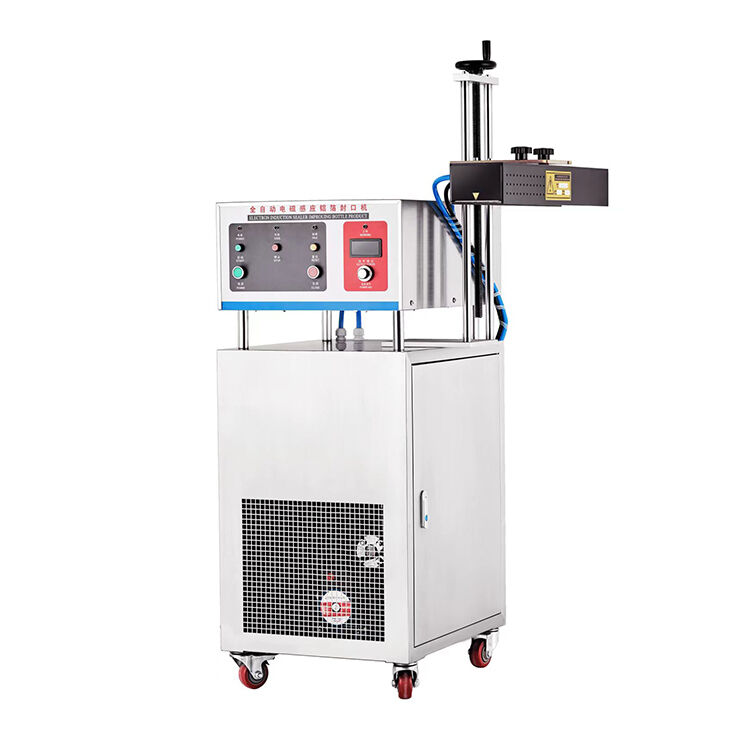
Automatic Induction Cap Sealing Machine Price
Induction sealer machines are non-contact devices designed to seal aluminum foil liners on the tops of containers such as bottles and jars. These machines utilize the induction sealing method to seal a wide range of containers without physical contact.
Induction sealing works by using an induction coil to generate heat, which melts thermoplastic materials and forms a secure seal. The most common application of induction sealing is cap locking, where the inner seal is heated without touching the container’s surface.
Primarily used in the packaging industry, induction sealer machines offer sealing solutions for sectors including pharmaceuticals, agrochemicals, healthcare, food, beverages, and petrochemicals. These machines ensure airtight sealing, protecting contents from contamination or leakage. Additionally, they provide tamper resistance, helping maintain product integrity.
Features:
1. An induction sealing machine operates based on the principles of electromagnetic induction. It is easy to use, as it can be operated with one hand, making it ideal for small-scale manufacturing operations.
2. The machine uses a hermetic sealing method, which effectively prevents leakage and contamination, providing excellent tamper resistance for packaging.
3. The efficiency of an induction sealer machine is enhanced by minimizing waste and maintaining the visual appeal of the package. Its calibration and setup are straightforward and user-friendly, allowing for seamless handling of various label sizes and types.
4. Equipped with internal counters and performance monitoring, the induction sealer machine detects errors and defects, preventing further damage and ensuring smooth operation.
5. The induction cap sealing machine is equipped with a range of optional components, adding flexibility and value to the system. As a high-performance tool, the induction sealer machine is designed to deliver consistent results based on accurate measurements.
Parameter
| Power |
2000W |
| Voltage |
AC 220V 50HZ 110V 60HZ |
| Sealing Diameter |
16mm-40mm |
| Capacity |
2.4-18m/min (180 bottles/min for 30mm diameter PET bottle |
| Bottle height |
30-260mm (special size for designing ) |
| Machine size |
Main Engine: 600mm*450mm*1200mm
Conveyor Table: 1800mm*180mm*1300mm |
| Machine Weight |
Main Engine:90Kg |
How do induction sealers meet the needs of industries like beverage, food, chemicals, lubricants, cosmetics, and pharmaceuticals?
Common Applications of Induction Sealer Machines
Beverage, Food, and Dairy
Induction sealing preserves freshness, prevents leaks, and deters tampering—crucial for products ranging from bottled water to dairy products and packaged snacks.
Chemicals, Lubricants, and Petroleum
By preventing container leaks, induction sealers help maintain safety and product quality for oils, solvents, and various chemicals.
Cosmetics and Personal Care
These machines ensure consumer confidence and preserve product integrity, making them essential for items like lotions, creams, and shampoos.
Pharmaceuticals
Induction sealers provide tamper evidence and help meet regulatory standards, such as FDA compliance, for medicines and health supplements.
Nutraceuticals
Sealing blocks oxygen and moisture, protecting powders, capsules, and tablets from contamination.
Liquids and Powders
Whether the product is a liquid syrup or a dry powder, induction sealing ensures consistent protection and packaging quality.
By catering to such a wide range of industries and product types, induction sealer machines have become an integral part of modern packaging lines, delivering reliable protection and compliance across the board.
How Does Induction Cap Sealing Machine Works?
An induction sealer machine uses a non-contact hermetic sealing process. The procedure begins when the machine receives bottles with caps from a capping machine. The bottle is passed beneath an induction coil, where it generates a hermetic seal. Induction sealing works by using electromagnetic induction to heat thermoplastic materials, causing them to bond. This process involves generating heat within a conductive material through eddy currents created by electromagnetic induction.
As the capped or closed container moves through the induction coil, it generates a spinning electromagnetic field. This field causes the conductive foil liner to heat up as it passes under the sealing head. The heat softens the wax in the liner, which detaches the foil from the cap. The polymer coating around the container’s rim then heats up and flows over the edge. As the package cools, the polymer forms a secure bond with the container, resulting in a completely sealed package.
The bottle and its contents remain unaffected by the process unless excessive heat is generated. Only if the foil overheats could the protective layer and seal be compromised. Inaccurate sealing can also occur if the induction seal is not properly sized for the container, highlighting the importance of accurate sizing to ensure proper operation of the sealing system.
What are the benefits of using induction sealing for sealing liquids versus powders?
Benefits of Induction Sealing for Liquids vs. Powders
Induction sealing is highly adaptable, making it suitable for both liquid and powder products, each with unique packaging needs. Key benefits include:
Sealing Liquids:
- Leak Protection: Creates a strong hermetic seal to prevent leakage during storage and transport—ideal for sauces, pharmaceuticals, and chemicals.
- Longer Shelf Life: Airtight sealing helps maintain freshness and protects against contamination and oxidation.
- Spill Resistance: Ensures bottles remain leak-proof even when tilted or shaken, preserving product quality.
Sealing Powders:
- Moisture Barrier: Prevents humidity from affecting powders like milk powder, spices, or supplements, avoiding clumping and spoilage.
- Tamper Evidence: Provides a visible seal to ensure product safety and integrity.
- Reduced Product Loss: Keeps fine powders securely contained, minimizing waste and mess.
Whether for liquids or powders, induction sealing offers secure, tamper-evident, and contamination-resistant packaging.

 Your message must be between 20-3,000 characters!
 english
 français
 Deutsch
 Italiano
 Русский
 Español
 português
 Nederlandse
 ελληνικά
 日本語
日本語
 한국
한국
 العربية
 हिन्दी
 Türkçe
 indonesia
 tiếng Việt
 ไทย
ไทย
 বাংলা
বাংলা
 فارسی
فارسی
 polski